Olive Garden Salad: Calories, Price, Ingredients & Copycat Dressing Recipe
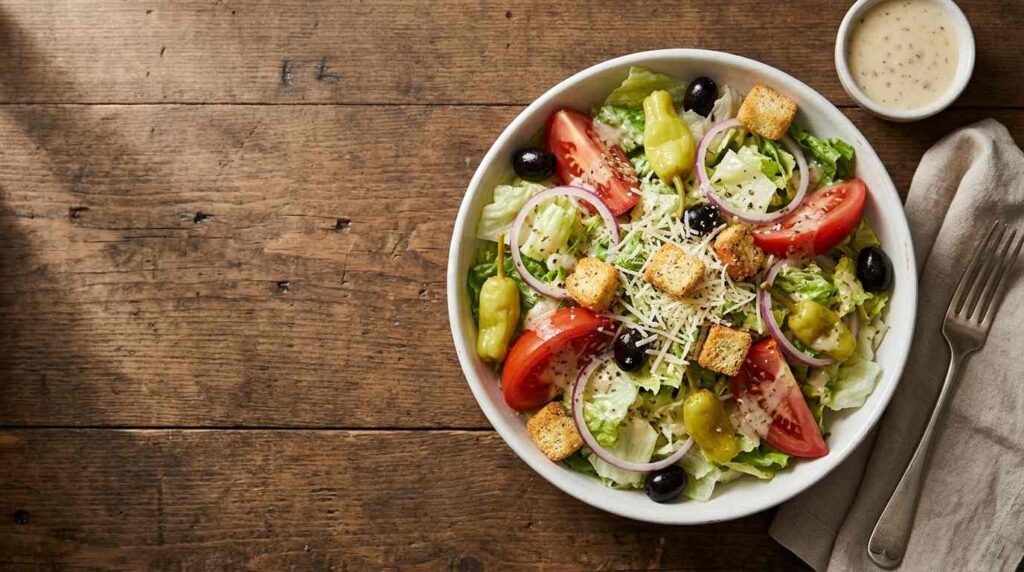
Quick Answer: How Many Calories in Olive Garden Salad?
150 calories per serving, with dressing. That is the official Olive Garden figure, and it is the number to use.
The 290-calorie figure you will see on other sites is not the salad alone. It is the salad (150 cal) plus one breadstick (140 cal). One aggregator even admits it in a footnote — its nutrition table “includes 1 breadstick and Italian dressing” — and then still lists 290 as the salad. Do not make that mistake when you order, and do not copy it into a diet tracker. If you eat the salad and skip the breadstick, you ate 150 calories. If you eat both, you ate 290.
Without croutons, the salad drops to 110 calories and appears on the gluten-sensitive menu. That is the lowest-calorie way to order it in the restaurant, and it is the only calorie change in this guide that comes from Olive Garden itself rather than a copycat site.
Key Facts
- Famous House Salad: iceberg and romaine lettuce, Roma tomatoes, red onion, black olives, pepperoncini, garlic croutons, and Parmesan cheese, tossed with Signature Italian dressing.
- 150 calories per serving with dressing. 110 calories without croutons. 290 calories with one breadstick.
- The lettuce is an “American blend” — iceberg, romaine, and julienned red cabbage, with matchstick carrots. You can buy the same blend in bags at the grocery store.
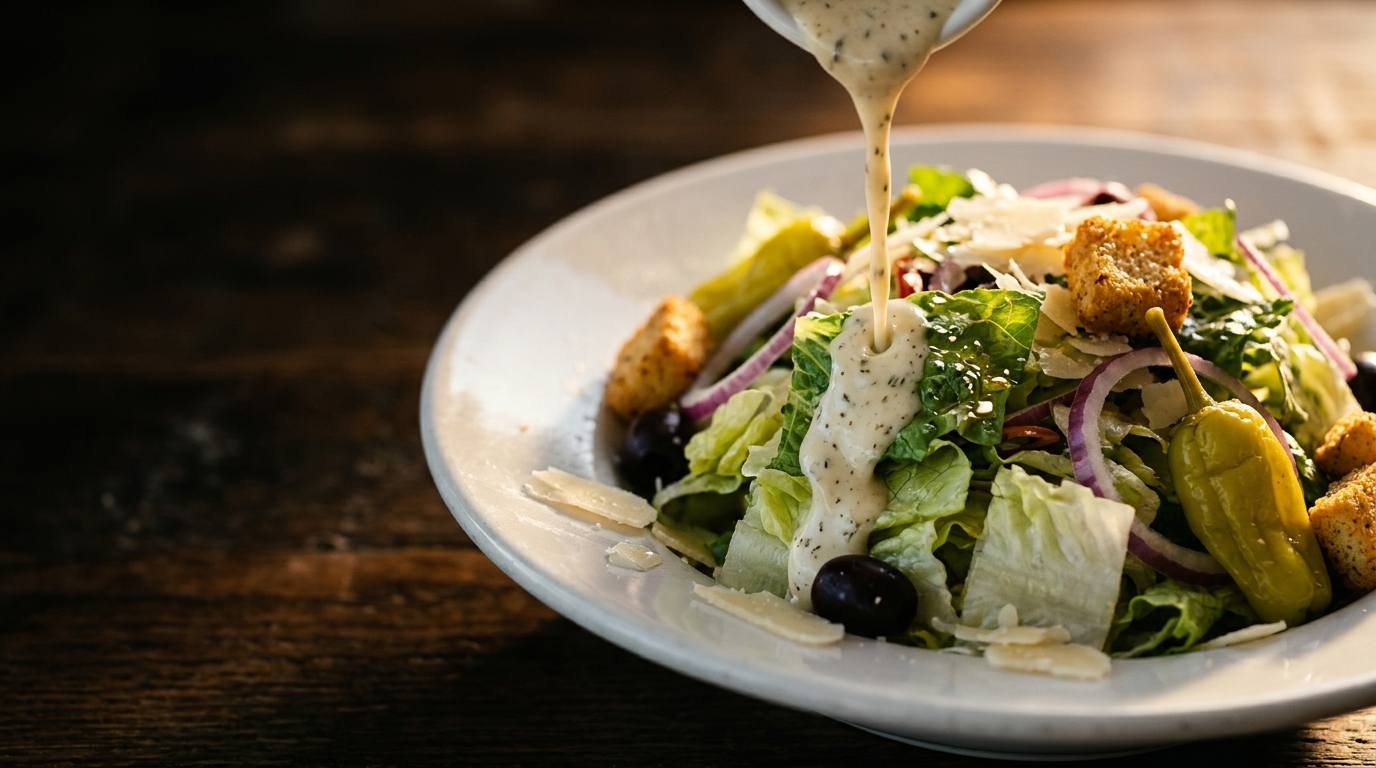
- The dressing is a creamy emulsified vinaigrette. The closest homemade version uses mayonnaise and vegetable oil, not olive oil.
- ToGo price is typically $8.99, with a range of $8.79 to $10.99 by location. Lunch menu: Famous House Salad $6.99. Prices vary — there is no single national price.
- Unlimited Soup, Salad & Breadsticks is $10.49 for weekday lunch (Monday to Friday until 2:30 PM) and $12.99 all day, dine-in only. On the lunch menu listing it is $10.99.
- Jumbo House Salad: $24.49, 1,650 calories for the full serving, serves 4 to 6, includes 12 breadsticks.
- Dressing is sold by the bottle at the host stand, and in grocery stores. The bottled version does not taste the same as the restaurant version.
- Free with any entrée, since 1982. Refills are unlimited for dine-in guests, portioned per person.
What Is in Olive Garden Salad?
The ingredient list is short, and that is the point. Crisp greens, a few salty and tangy toppings, crunchy croutons, Parmesan, and a dressing that ties it all together. Nothing in it is fancy. Everything in it has a job.
Here is the full list, as Olive Garden describes it:
- Iceberg lettuce and romaine lettuce
- Roma tomatoes, sliced
- Red onion, thinly sliced
- Black olives, whole and pitted
- Pepperoncini, whole
- Garlic croutons
- Parmesan cheese, freshly grated
- Signature Italian dressing
The lettuce is where the copycat recipes argue with each other, and the argument has a simple answer. One creator review in the research puts it plainly: iceberg plus romaine plus julienned red cabbage is called an “American blend,” and you can buy American blend salad mix in bags already at the grocery store. That is why some recipes list red cabbage and matchstick carrots and some do not — the cabbage and carrots are in the bagged mix, not in Olive Garden’s own ingredient description. If you buy the bag, you get them. If you chop lettuce by hand, you do not need to add them separately.
What is not in the salad matters too, because people keep asking. There are no jalapeños in Olive Garden salad — that is a direct reply in the research, and it is worth one line because the question keeps coming up. There is no cucumber, no bell pepper, and no chicken in the standard salad. If you want protein, you add it: grilled chicken, shrimp, or even chicken parmigiana on top, all available as add-ons.
The toppings are portioned, not piled on. A worker reply in the research says the salad is made with two tomatoes, two olives, and two pepperoncinis per serving, with red onion sliced thin. Another worker’s reply, for a larger “Limited Salad” portion, lists six tomatoes, six black olives, and about four pepperoncinis. Those two answers conflict, and the “no more than 2 olives per salad” complaint in another thread conflicts with both. I am not publishing a single olive count as official, because the workers themselves do not agree — and that disagreement is exactly why some tables get two olives and some get six.
All Olive Garden Salad Menu Items — Easy List
A salad at Olive Garden is either the Famous House Salad that comes free with an entrée, or a salad ordered on its own. The House Salad is the light one. The Caesar salads are the heavy ones. Here they are, side by side.
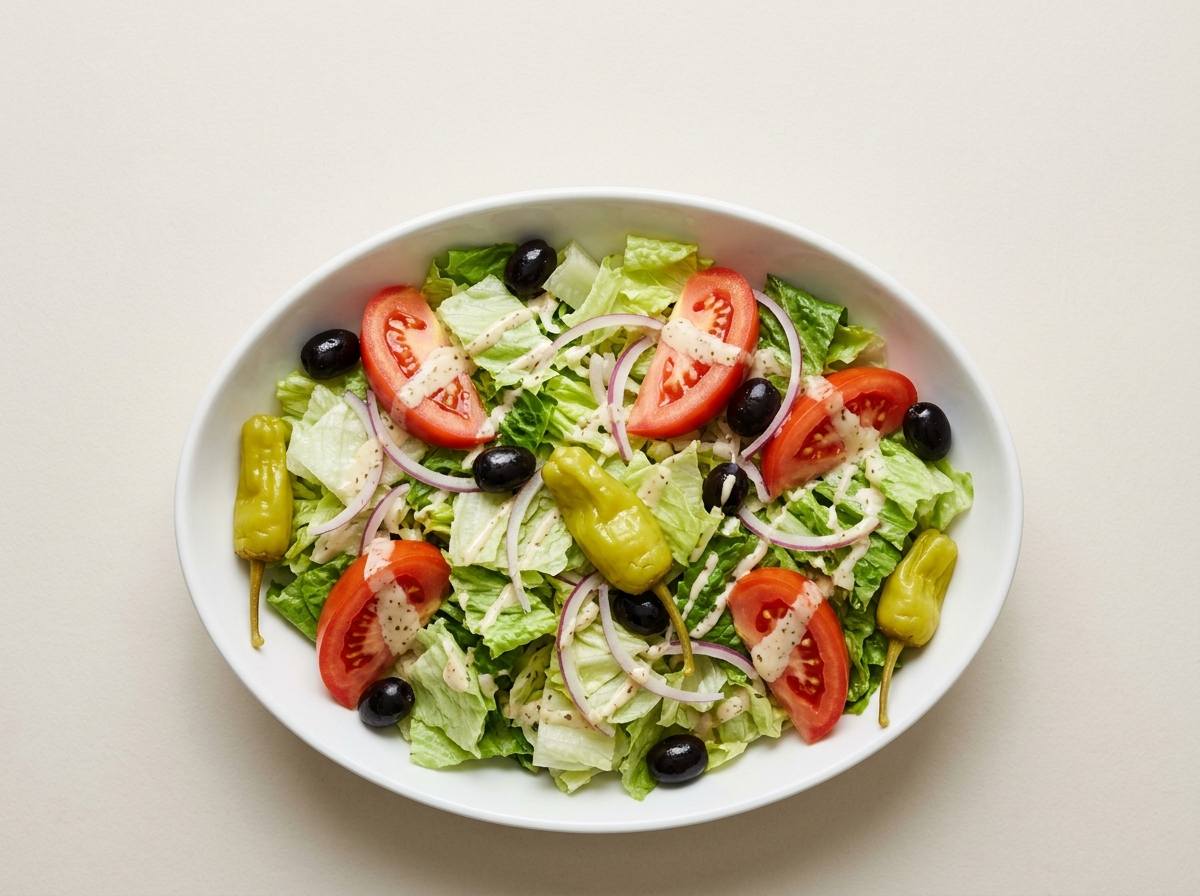
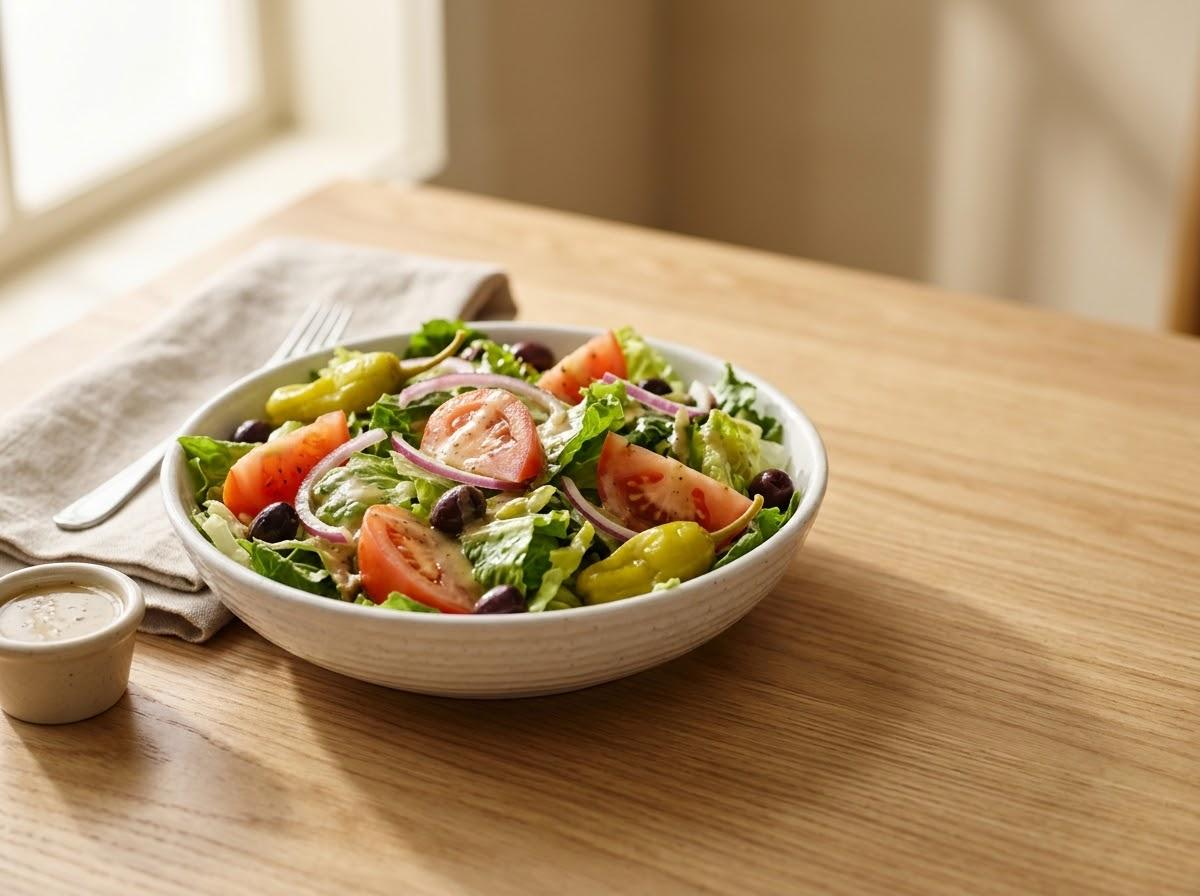
Famous House Salad
USD $6.99 | 150 cal
Crisp greens, tomatoes, red onion, olives, and pepperoncini with signature Italian dressing.
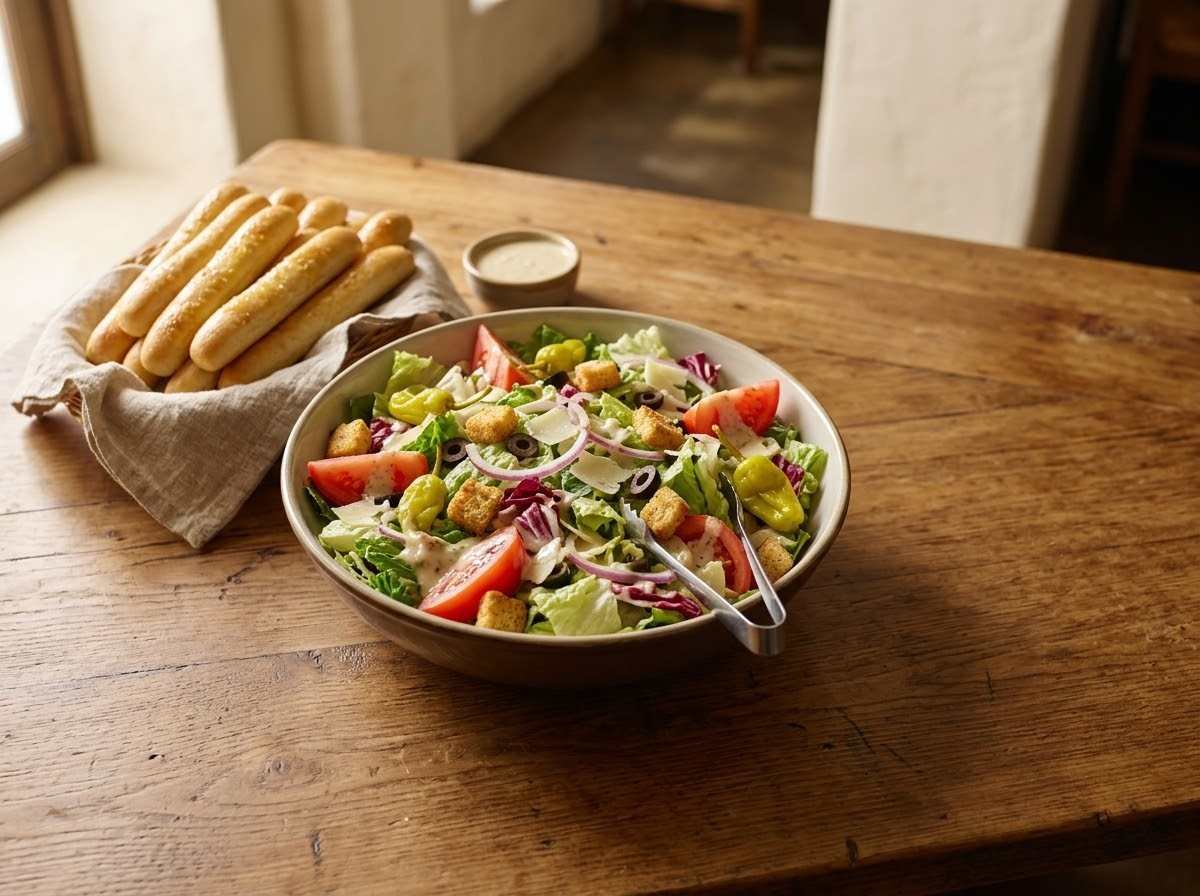
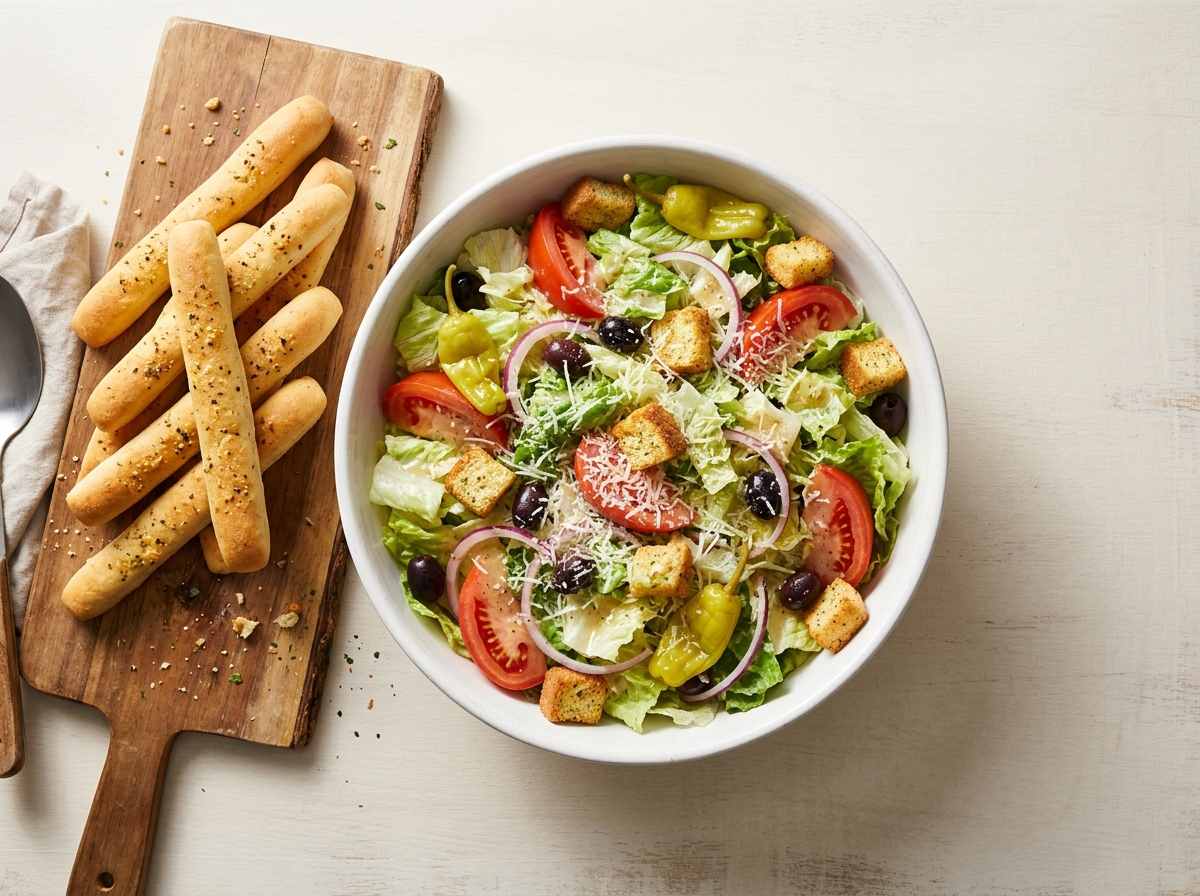
Jumbo House Salad
USD $24.49 | 1,650 cal
or the full serving, serves 4 to 6 — The same Famous House Salad in family size, with 12 breadsticks.
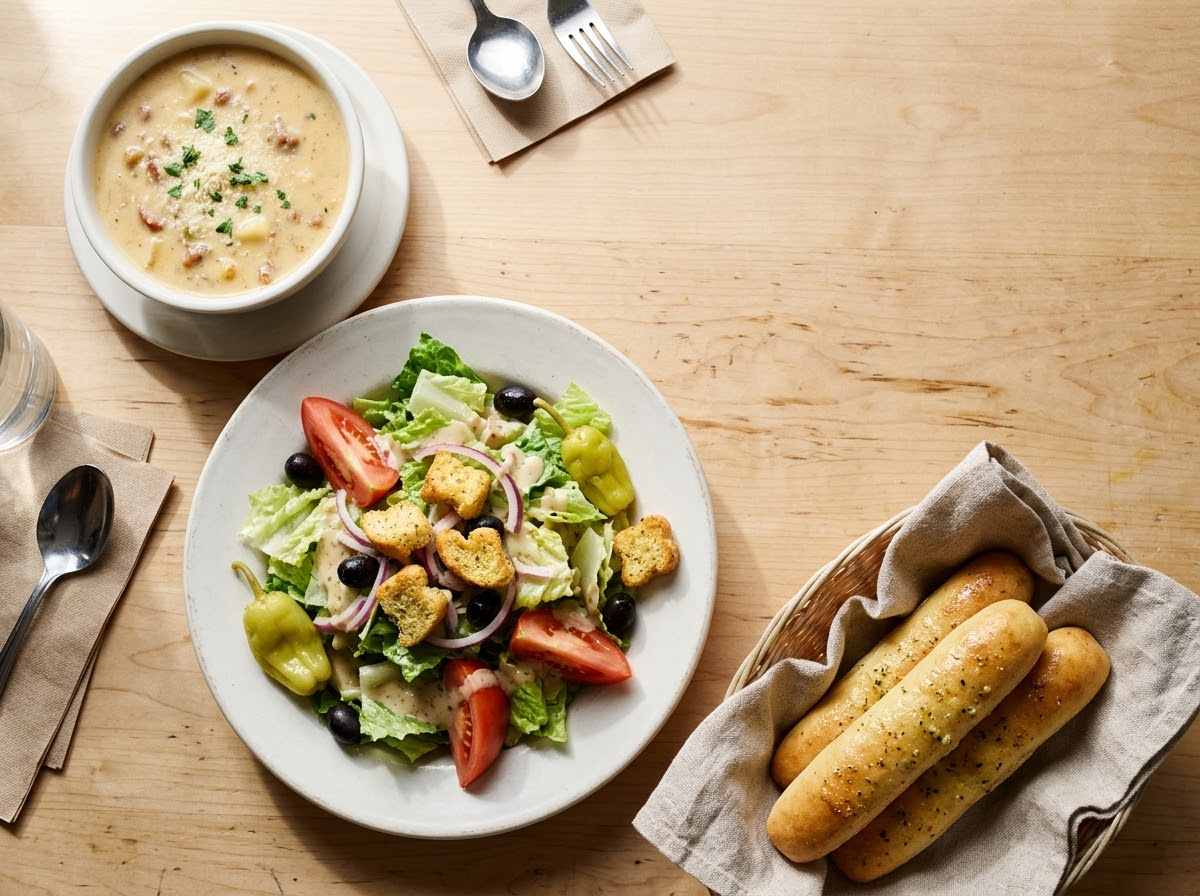
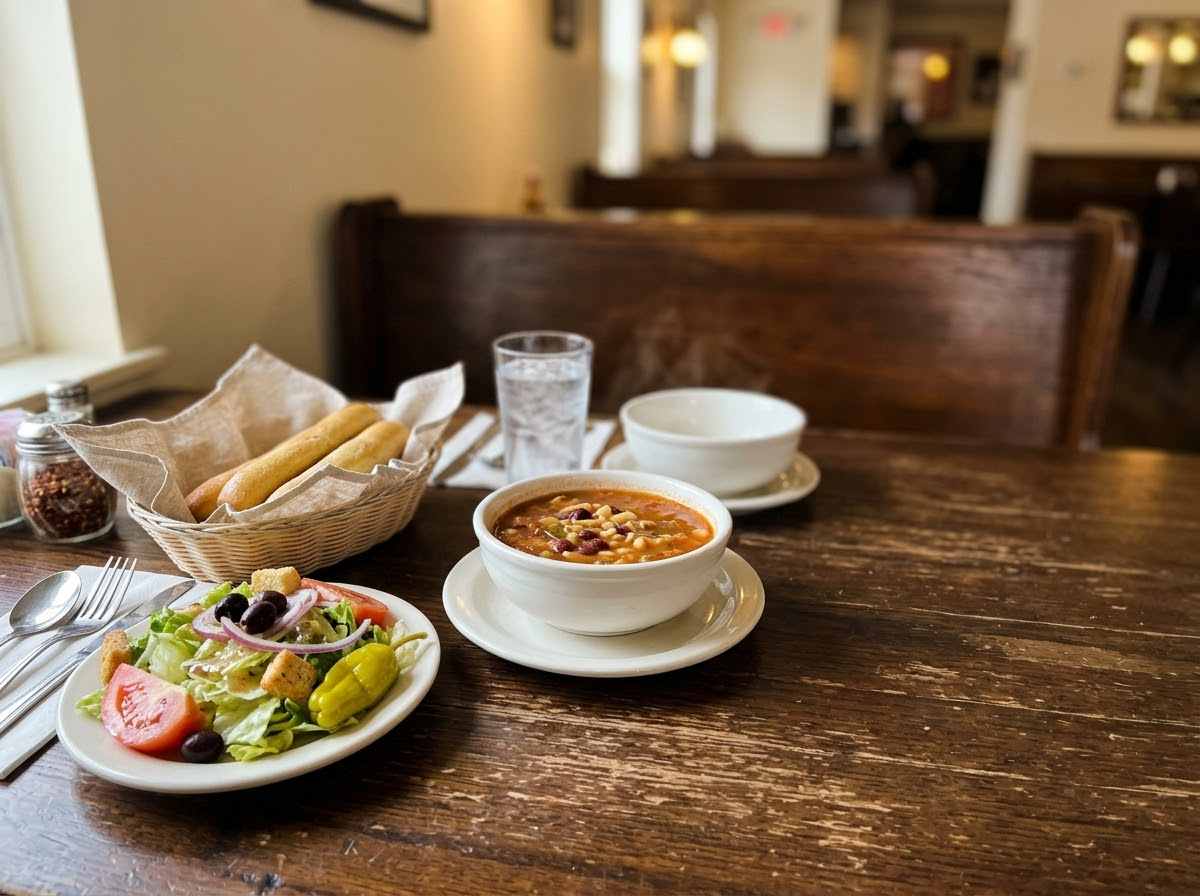
Soup, Salad & Breadsticks
USD $10.99 | 400–520 cal
All-you-can-eat soup of choice, house salad, and warm breadsticks. Dine-in only.
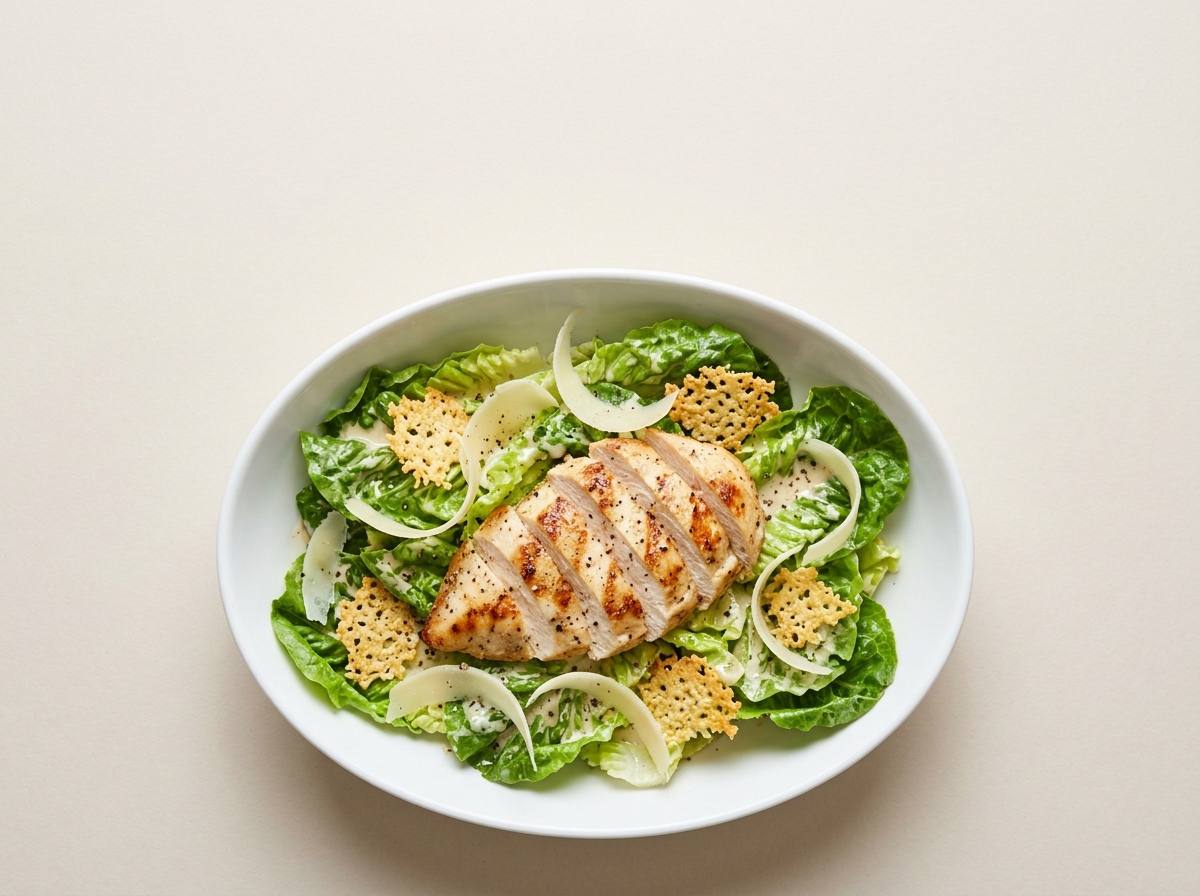
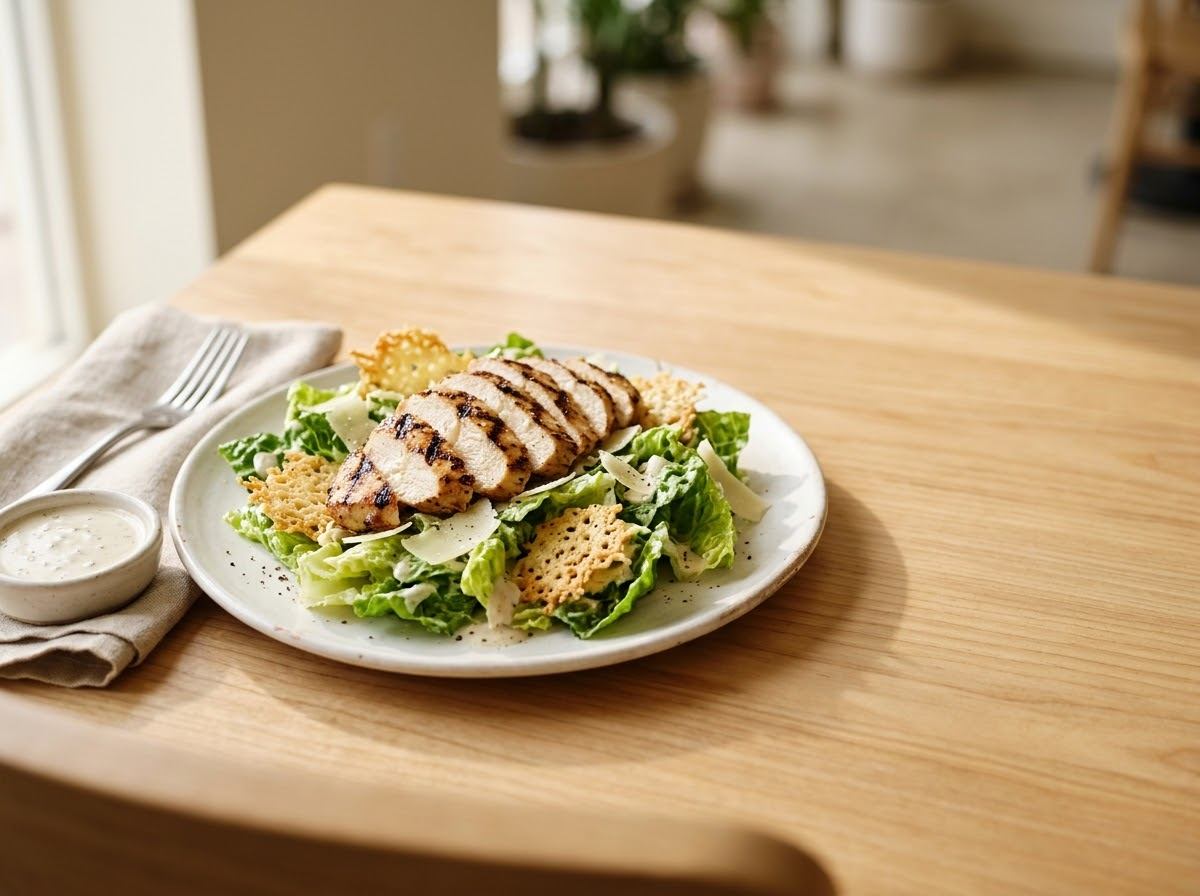
Grilled Chicken Caesar Salad
USD $12.99 | 850 cal
Grilled chicken over romaine with Caesar dressing, shaved romano, and parmesan crisps.
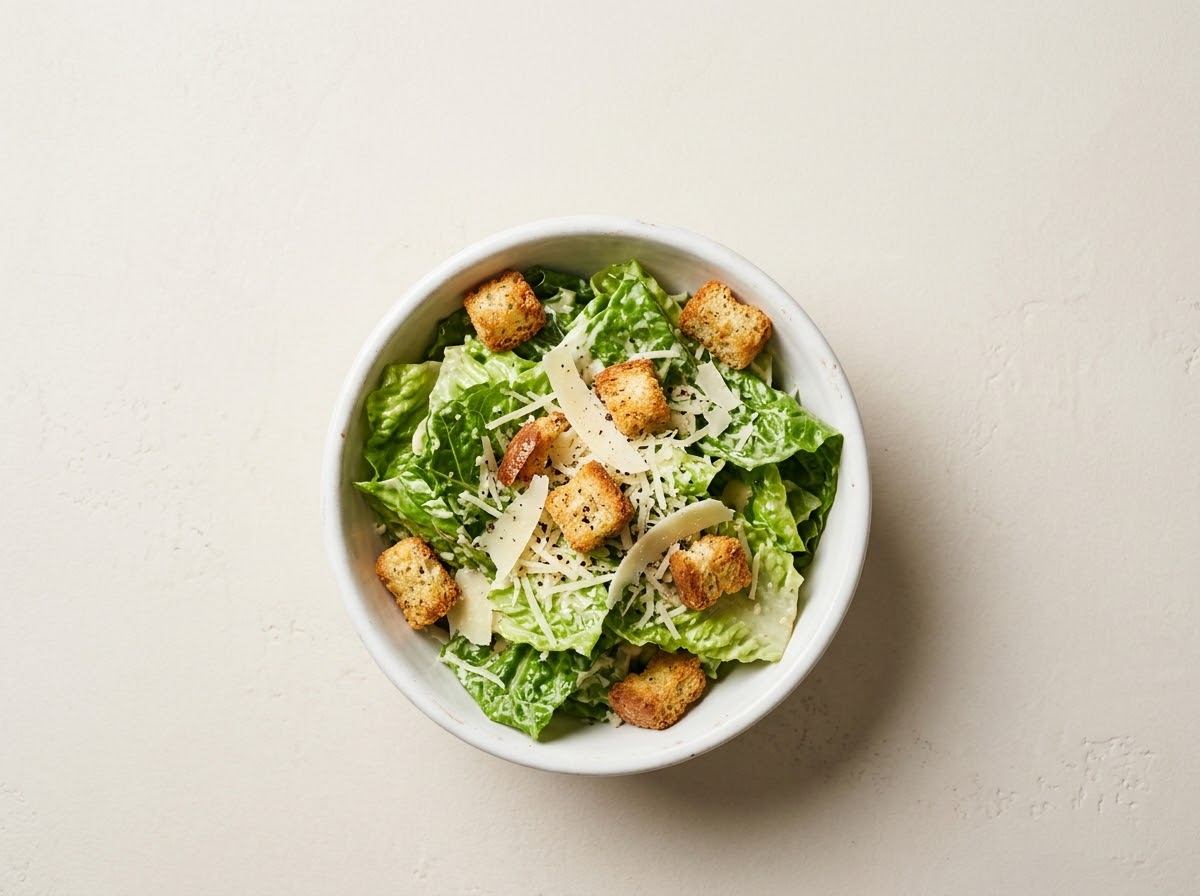
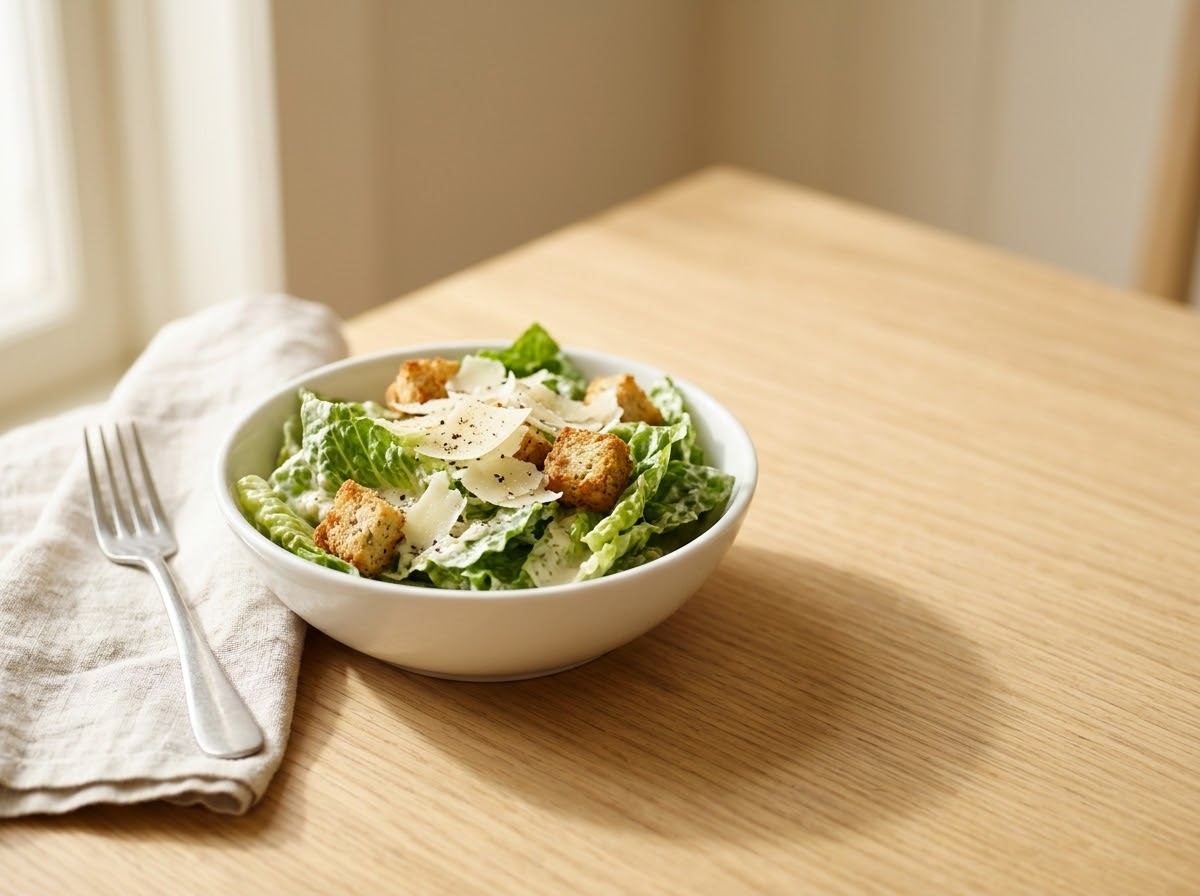
Caesar Salad (Side)
USD $6.99 | 330 cal
Crisp romaine with Caesar dressing, croutons, and shaved parmesan.
Olive Garden Salad Calories and Nutrition
This is the table no other page keeps straight, because most pages mix up the salad, the breadstick, and the dressing. Here it is, with each figure labelled by what it actually includes:
| Salad Build | Calories | What It Includes |
| Famous House Salad, with dressing | 150 | Salad with Signature Italian dressing |
| Famous House Salad, without croutons | 110 | Salad with dressing, no croutons |
| Famous House Salad, without dressing | 70 | User-thread figure; conflicts with official information — see note |
| Famous House Salad + 1 breadstick | 290 | Salad (150 cal) + breadstick (140 cal) |
| Jumbo House Salad, full serving | 1,650 | Salad + 12 breadsticks; serves 4–6 |
| Breadstick, 1 | 140 | 460 mg sodium per breadstick |
Read the third row carefully. A user thread says Olive Garden “lists one serving of the salad as 70, without dressing.” That conflicts with the official 150 with dressing and 110 without croutons, and the reply in that same thread only estimates it as “close to 70 cal, maybe a little more.” I am flagging it here rather than publishing it as a fact, because no official menu I checked lists 70 as the current figure. If you track calories, use 150 with dressing and 110 without croutons. Those are the two figures Olive Garden itself publishes.
Sodium is the same story, and it is worse. One creator review states 770 mg of sodium per serving with dressing. One aggregator lists 600–700 mg. Another lists 1,520 mg — but that table includes a breadstick, so it is not the salad alone. I am not publishing a single sodium figure as official, because the sources conflict and none of them is the official nutrition guide. What is certain is the direction: the dressing is most of the sodium, a breadstick adds 460 mg each, and a salad plus soup plus breadsticks can pass 2,300 mg — a full day’s worth — in one meal. If sodium matters to you, ask for dressing on the side and stop at one breadstick. That advice holds no matter which sodium figure is right.
The copycat nutrition is even messier, and it is worth naming because it explains why three “same” recipes give three different calorie counts:
| Copycat Source | Servings | Calories per Serving | Why It Differs |
| The Recipe Critic | 4 | 156 kcal | Light dressing and small servings |
| Taste and Tell | 6 | 264 kcal | Half the dressing; labeled as an estimate |
| My Olive Garden Copycat (user post) | 1 bowl | 268 kcal | Full bowl with light dressing |
| Kitchen Fun With My 3 Sons | 4–6 | 585 kcal | Full dressing packet and larger servings |
The difference is serving size and how much dressing is used, not the salad. A 156-calorie copycat and a 585-calorie copycat can both be “correct” for the portion they made. Do not compare them without checking the servings. For the restaurant salad, use the official 150. For a copycat, use the recipe’s own serving size and measure the dressing — do not pour it straight from the jar.
Olive Garden Salad Price and Unlimited Soup, Salad & Breadsticks
Olive Garden has no national price list. Prices vary by location and by date, and the official menu PDFs from different dates prove it — the same Soup, Salad & Breadsticks meal appears at $9.49, $10.99, $11.49, $11.99, $12.49, and $14.99 in different menus. Any page that gives you one price as “the price” is giving you one location on one date. Here is the range, labelled:
| Item | Typical Price | Range Found | Note |
| Famous House Salad, ToGo | $8.99 | 8.79–10.99 | Single serving, to go |
| Famous House Salad, older listings | $8.49 | — | Older menu price; don’t use as current |
| Soup, Salad & Breadsticks, weekday lunch | $10.49 | 9.99–13.49 | Dine-in, Monday–Friday until 2:30 PM |
| Soup, Salad & Breadsticks, all day | $12.99 | 12.49–15.99 | Dine-in, unlimited |
| Jumbo House Salad + 12 breadsticks | $24.49 | 24.49–25.99 | Family-style; serves 4–6 |
| Unlimited Salad only | $8.49 | Location-specific | Price from a user post; not verified as an official price |
Olive Garden Salad Price and Calories (Lunch Menu)
Prices and calories from the Olive Garden lunch menu listing, November 2026. Prices vary by location — check the app for your store.
Famous House Salad
Famous House Salad — $6.99, 150 cal with dressing, Vegetarian, ★ 4.8 (38 ratings) — Crisp greens, tomatoes, red onion, olives, and pepperoncini with signature Italian dressing.
The unlimited deal
Soup, Salad & Breadsticks (Unlimited) — $10.99, 400–520 cal, Vegetarian, ★ 4.5 (54 ratings) — All-you-can-eat soup of choice, house salad, and warm breadsticks.
The 400–520 cal range on the unlimited deal is per serving, not the whole meal — one bowl of soup plus one salad is about 400–520 cal, and refills are extra.
The unlimited meal is the best value on the menu, and it is also the most misunderstood. It is a standalone meal — you do not need to order an entrée to get it. The weekday lunch is $10.49 until 2:30 PM, Monday to Friday. The all-day version is $12.99. Both are dine-in only, both let you change soups on each refill, and both include unlimited salad and breadsticks. That is the official deal, and it is the answer to the most asked question in the research: “Can I dine in for strictly salad? How much is it?”
The rules that catch people out are the ones no menu page states plainly:
- Refills are per person, not per table. The salad is portioned by party size — one line on the size guide for 1–2 people, the next for 3, the next for 4–5, and two smaller salads for more than 5. Sharing one unlimited salad between six people will get you charged, and a worker reply in the research says so directly: the salad is made “the size based on the number of people that ordered.”
- To-go is not unlimited. You get one salad for every entrée you order to go, and it arrives as a fresh packaged salad, not a refill.
- Kids menu entrées do not come with never-ending salad. That is a direct reply in the research, and it surprises parents.
- Servers will keep offering refills. One thread says staff are “pretty much told to ask for refills constantly.” Say no when you are full — the refill is free, but the calories are not.
For the soup side of this meal, see the Olive Garden Soups Menu.
Olive Garden Salad Dressing: The Recipe, the Bottle, and the 3 Schools
The dressing is why people go to Olive Garden for a salad. It is also why no two copycat recipes agree. There are three schools of copycat dressing, and every competitor page picks one and pretends the other two do not exist. Here they are, side by side:
| Dressing Style | Base | Key Ingredients | Closest to Restaurant-Style? |
| Packet | Good Seasons Italian dressing packet | Olive oil, vinegar, water, Dijon, mayonnaise | Easiest option; good flavor |
| Mayo + cheese | Mayonnaise and vegetable oil | Parmesan, Romano, corn syrup, lemon | Closest, according to CopyKat |
| Vinaigrette | Olive oil | Vinegar, mayonnaise, lemon, Italian seasoning | Lightest option; least like the restaurant version |
The packet school uses a 1.7-ounce Zesty Italian Dressing Mix packet with 3/4 cup olive oil, 1/3 cup white vinegar, 1/4 cup water, a teaspoon of Dijon, a tablespoon of mayo, and a pinch of sugar and garlic powder. It is the easiest version to make, and it is the one most recipe sites use.
The mayo-and-cheese school is the one the best dressing page in the research recommends. Copykat’s version is 1/2 cup mayonnaise, 1/3 cup white vinegar, 1 teaspoon vegetable oil, 2 tablespoons light corn syrup, 2 tablespoons Parmesan, 2 tablespoons Romano, garlic salt, Italian seasoning, parsley, and a tablespoon of lemon juice. Its key insight is the one no other page states: Olive Garden does not use olive oil in its dressing. The dressing is a creamy emulsified vinaigrette — mayonnaise plus vegetable oil, with the creaminess coming from the mayo and the body from the oil. A dressing made with only olive oil will taste thinner and more bitter than the restaurant version. The corn syrup is not a mistake either — it gives the dressing its slightly thick, clingy texture and balances the vinegar. Let it rest in the fridge for at least an hour before serving, so the dried herbs rehydrate. It keeps for 10 days in the fridge. Do not freeze it — mayonnaise dressings separate when frozen and cannot be fixed.
The vinaigrette school is the lightest: 3/4 cup olive oil, 1/3 cup white vinegar, 1/4 cup water, 2 tablespoons mayonnaise, a tablespoon of Parmesan, and Italian seasoning, salt, sugar, onion powder, garlic powder, oregano, parsley, and pepper. It is a good dressing. It is not the closest to the restaurant.
There is also a fourth option, and it is the one most people actually use: buy the bottle. Olive Garden has sold bottles of Signature Italian dressing at the host stand since at least 2010, tested it at Sam’s Club two years later, and now sells it in almost all supermarkets. It also sells a Light version with less than half the calories and fat. But the bottled version does not taste the same as the restaurant version — Copykat says it “contains preservatives, stabilizers, and a different flavor profile,” and a user post in the research says the same thing in plain words: “I broke down and got the bottled Olive Garden Light dressing, because I just can’t make it taste the same.” If you want the restaurant taste, make the mayo-and-cheese version at home. If you want convenience, buy the bottle and accept the difference.
You can also ask for a different dressing in the restaurant. The house-made Italian is the default, but a low-fat option and plain oil and vinegar are available on request, and some guests order half ranch and half Italian. Ask — the menu does not list every dressing choice.
How Is Olive Garden Salad Made?
The salad is assembled at a salad station, not cooked. The lettuce mix comes in a bag, the onions and tomatoes are sliced daily, and the olives come from a can. That is a worker reply from the most commented thread in the research, and it is the honest answer to the “what’s the secret?” question: there is no secret technique. The secret is fresh produce, sliced that day, and a dressing that is made to be addictive.
The station setup, from another worker reply, is standard: salad mix in a full pan, then tomatoes, onions, olives, and peppers in third pans, right to left. The salad is sized by party, tossed or layered depending on the server, and served immediately. One thread asks “which way do you do your salads?” and the top customer reply is blunt: “Salads should be well mixed.” If yours arrives layered with all the toppings on top, ask for it tossed — that is a normal request, not a complaint.
Every table is greeted with salad. One thread asks how servers are supposed to greet a table in less than 30 seconds with salad, and whether that defeats the point of choosing between soup and salad. It does not — the salad arrives first, the soup follows, and the refills keep coming until you say stop. That is the Never-Ending first course, and it has worked that way since the restaurant opened in 1982.
Copycat Olive Garden Salad Recipe
This is the reconciled recipe — the salad from the restaurant build, with the dressing from the mayo-and-cheese school, because that is the closest to the restaurant taste. The other two dressing versions are listed below it, labelled, so you can pick. None of these is the official Olive Garden recipe. Olive Garden does not publish it. These are creator versions, and I am labelling them as such.
Salad — serves 6
- 2 (5-ounce) packages American salad mix, or 6 cups chopped iceberg + 2 cups chopped romaine + 1 cup shredded red cabbage + 1/4 cup shredded carrots
- 2 Roma tomatoes, sliced
- 1/2 cup thinly sliced red onion
- 3/4 cup pitted black olives
- 3/4 cup pickled pepperoncini, whole or sliced
- 1 cup garlic croutons
- 1/2 cup freshly grated Parmesan cheese, divided
Dressing — the closest version (Copykat school)
- 1/2 cup mayonnaise
- 1/3 cup white vinegar
- 1 teaspoon vegetable oil
- 2 tablespoons light corn syrup
- 2 tablespoons grated Parmesan cheese
- 2 tablespoons grated Romano cheese
- 1/4 teaspoon garlic salt, or 1 clove garlic, minced
- 1/2 teaspoon Italian seasoning
- 1/2 teaspoon dried parsley flakes
- 1 tablespoon lemon juice
Steps
- Make the dressing first. Blend or whisk all dressing ingredients until smooth, about 30–60 seconds. Refrigerate for at least 1 hour before serving.
- Combine the salad mix, olives, pepperoncini, onion, tomatoes, and croutons in a large bowl.
- Drizzle with half the dressing and toss gently. Top with the remaining Parmesan. Serve the rest of the dressing at the table.
- Toss 5 to 10 minutes before eating — not earlier, or the croutons go soggy and the lettuce wilts.
The other two dressing versions, labelled:
- Packet version: 1.7-ounce Zesty Italian packet, 3/4 cup olive oil, 1/3 cup white vinegar, 1/4 cup water, 1 teaspoon Dijon, 1 tablespoon mayo, 1/2 teaspoon sugar, 1/2 teaspoon garlic powder. Shake in a jar.
- Vinaigrette version: 3/4 cup olive oil, 1/3 cup white vinegar, 1/4 cup water, 2 tablespoons mayo, 1 tablespoon Parmesan, 1 teaspoon Italian seasoning, 1 teaspoon salt, 1 teaspoon sugar, 1/2 teaspoon each onion powder, garlic powder, oregano, and parsley, 1/4 teaspoon pepper. Blend.
Storage: Dressing keeps 10 days in an airtight container in the fridge. Do not freeze it. Salad is best served right away. If you need to make it ahead, do not add dressing until just before serving. Undressed leftovers keep up to 1–2 days in the fridge. Dressed leftovers do not keep — the lettuce goes soggy overnight.
A 268-calorie copycat bowl from a user post in the research is a useful check: with light dressing and a single bowl, a homemade version lands around 268 kcal. That is higher than the restaurant’s 150 because a home bowl is bigger than one restaurant serving and the dressing is poured more generously. Measure the dressing if calories matter to you.
Is Olive Garden Salad Healthy?
Yes as a starter, no as a free-for-all. At 150 calories with dressing, the salad itself is one of the lightest things on the menu. The problem is never the lettuce. It is the sodium, the breadsticks, and the refills.
One serving with dressing carries a significant share of your daily sodium — the figures in the research range from 600 mg to 770 mg, and a breadstick adds 460 mg more. Eat two bowls of salad and two breadsticks and you have eaten most of a day’s sodium before your entrée arrives. That is why the salad tastes so good and why it is not guilt-free. Salt is doing a lot of the work.
The healthiest way to order it is simple: dressing on the side, no croutons (110 cal), one breadstick or none, and stop at one bowl if you are also eating soup and an entrée. The least healthy way is also simple: unlimited refills with full dressing, three breadsticks, and a creamy soup on the side. Same salad, very different meal.
Is Olive Garden Salad Vegan, Vegetarian, or Gluten-Free?
Three different questions, three different answers. Here is the matrix:
| Diet | As Served? | What to Change |
| Vegetarian | Yes | Nothing — the salad as served is vegetarian. |
| Vegan | No | Remove the cheese and swap the dressing for oil and vinegar. |
| Gluten-sensitive | Yes, without croutons | Remove the croutons. It’s 110 calories without them, but not certified gluten-free. |
| Dairy-free | No | Remove the cheese and dressing. |
| Low-carb | Yes, with changes | Remove the croutons and breadsticks. |
Vegetarian: Yes. The salad as served is vegetarian.
Vegan: No, as served. The cheese and the dressing both contain dairy, and the dressing contains egg. Order it with no cheese and oil and vinegar instead of the house dressing. One user post in the research raises a harder point: Parmesan and Romano are “blatantly not vegetarian” in the strict sense, because they are traditionally made with animal rennet. I am labelling that as a user concern, not an official Olive Garden statement — but if you are strict vegetarian or vegan, it is worth knowing before you order.
Gluten-free: Not certified gluten-free.
Order it without croutons and it is on the gluten-sensitive menu at 110 calories, but Olive Garden itself says it “may not meet the definition of gluten-free because gluten-containing ingredients are prepared in our kitchen.” Do not present it as certified gluten-free. The dressing itself contains no wheat, but the croutons do, and cross-contact is possible.
Allergens: Dressing contains milk, egg, and sulfites. Croutons contain wheat. Tell your server about any allergy — the menu does not list every ingredient.
Pain Points: What Goes Wrong With Olive Garden Salad
A good guide names the problems, not just the positives. Here are the ones that come up again and again in user posts, with the honest answer for each.
Too few olives, too few croutons. The most common complaint is portioning: “My Olive Garden salad came with literally two croutons,” and “no more than 2 olives per salad.” Both are single-table stories, not a policy — but they are the same complaint, and the fix is the same: ask for extra olives or croutons when you order. It is a normal request.
Layered, not mixed. Customers hate a salad that arrives with all the toppings sitting on top. Ask for it tossed. If it arrives layered, toss it yourself at the table — the dressing is on the side for exactly that reason.
Soggy by the second bowl. The salad is best fresh. Dressing poured too early wilts the lettuce and softens the croutons. At home, toss 5 to 10 minutes before eating and keep the dressing on the side. In the restaurant, ask for dressing on the side if you plan on refills.
The dressing is the calories. At 102 calories per serving for the Copykat version, and with most people pouring far more than one serving, the dressing can double the salad’s calories without you noticing. Dip instead of pouring.
Sharing gets charged. One unlimited salad does not feed six people for free. The salad is portioned per person, and sharing incurs a charge. Order the Jumbo House Salad instead — $24.49, serves 4 to 6, with 12 breadsticks. It is cheaper than six individual salads and it is the order the size guide is built for.
It is not free. “Is Olive Garden unlimited soup and salad free?” No. It is included with an entrée, or it is the $10.49 lunch / $12.99 all-day meal. The salad arrives before you pay, which makes it feel free. It is not.
The bottled dressing disappoints. The grocery-store bottle is convenient, but it does not taste like the restaurant dressing. If you buy it and it tastes too salty or too thin, that is the preservatives and the different recipe, not your cooking. Make the homemade version if taste matters more than convenience.
How We Checked This Guide
This guide was built from Olive Garden’s own menu PDFs as the authority for calories and the Never-Ending terms, with menu aggregators checked live for prices and the conflicts labelled by source and date. Four copycat recipe pages were compared line by line for ingredients, dressing, servings, and nutrition, and their conflicts — lettuce, dressing school, olive count, copycat calories, sodium — are stated in the guide rather than averaged away.
About 95 user-post titles were used as demand evidence only. They tell us what people ask, what they like, and what frustrates them. They do not set prices, nutrition, or policy. Four creator video reviews were used as experience evidence only — the American blend definition, the toss timing, the dressing recipe, and the sodium figure. No comment bodies arrived in the research, so no comment is quoted as a fact.
No search-volume or difficulty figures are quoted in this guide, because none were verified for the exact keywords. No location, zip code, or landmark is presented as official. Prices are ranges with a check-your-store rule, because Olive Garden has no national price list. If a figure in this guide changes, it will be because Olive Garden changed its menu, not because a rival site changed its price.
Frequently Asked Questions
Bottom line
Order the Famous House Salad for 150 calories with dressing, 110 without croutons, and do not let anyone tell you it is 290 — that is the salad plus a breadstick. The dressing is the whole game: make the mayo-and-cheese version at home if you want the restaurant taste, buy the bottle if you want convenience, and ask for it on the side if you want the calories to stay low. And if you are hungry, order the $10.49 lunch or $12.99 all-day Soup, Salad & Breadsticks meal instead of a single salad — it is the best value on the menu, and the salad refills are the point.